Showing posts with label english article. Show all posts

Friday, 11 November 2011

'Eiduladha Sermon 2011: The Sacrifices of Life


On this day, I was asked again by the Sri Lankan Muslim Association to lead the eid prayer and give a sermon. Given the examination period, the sermon was not as intense as the 'Eidulfitr sermon. Nevertheless, the main thing was to convey the lessons learnt from 'Eiduladha.

The sermon took place at a community hall in Oakleigh.


FIRST SERMON

Praise is to Allah who hath guided us to this; and we would not have been guided if Allah had not guided us. We praise Him, we seek His help, and we ask for His forgiveness. Whomever Allah guides, no one can lead him astray, and whoever is led astray by the will of Allah, no one can bring him back.
We bear witness that there is but one Allah, and Muhammad S.A.W. as his messenger, and the last messenger appointed by Allah.

O servants of Allah! Fear Allah! Fear Allah the way He deserves to be feared. And do not die as Muslims in full state of submission to Allah.

My dear brothers and sisters,

Today we celebrate the day of ‘Eidul-adha, in conjunction with two important things in Islam;
1. The ritual of hajj, which makes one of the five pillars of Islam
2. The ritual of sacrifice, to enliven the symbol that was performed by the prophet Ibrahim a.s.

With the conjunction of hajj which has been made compulsory by Allah to those who can afford so; they answer the call of Allah to perform hajj.
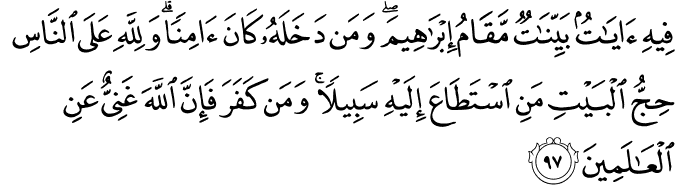


“…and pilgrimage to the House is incumbent upon men for the sake of Allah, (upon) everyone who is able to undertake the journey to it; and whoever disbelieves, then surely Allah is Self-sufficient, above any need of the worlds.”
[Aali-‘Imran, 3:97]


Ever since the month of Shawwal, people have been on pilgrims to gather at the holy city of Makkah to answer the call of Allah, they answer with hearts of faith, performing what has been appealed by prophet Ibrahim a.s.; performing the hajj, worshipping the one Lord, facing in the one direction, following the path of prophet Muhammad S.A.W., and becoming an ummah that has been united under Islam, as how Allah S.W.T. has commanded:



“The Believers are but a single Brotherhood: So make peace and reconciliation between your two (contending) brothers; and fear Allah, that ye may receive Mercy.”
[Al-Hujuraat, 49:10]


The prophet Muhammad S.A.W. is the last prophet appointed by Allah as the messenger to mankind, which comprises of different nations and descendants, of different backgrounds, rank, wealth, and knowledge. They have been called upon to unite in the name of Islam, as how Allah has advised in the Quran:



“O mankind! We created you from a single (pair) of a male and a female, and made you into nations and tribes, that ye may know each other (not that ye may despise (each other). Verily the most honoured of you in the sight of Allah is (he who is) the most righteous of you. And Allah has full knowledge and is well acquainted (with all things).”
[Al-Hujuraat, 49:13]


From a distance everyone looks the same; they wear the same garments, each of them not revealing their racial background, be they Arabs, Africans, Europeans, or Asians. No one knows who is a president, who is a cleaner, who is a minister, who is a civil servant.


The ritual of hajj witnesses the mass gathering of Muslims from the far corners of the world, glorifying the oneness of Allah upon wearing their ihram clothings by chanting the talbiyah,

“Here I am at Thy service O Lord, here I am. Here I am at Thy service and Thou hast no partners. Thine alone is All Praise and All Bounty, and Thine alone is The Sovereignty. Thou hast no partners."

They gathered despite their differences in nationality and language, not being able to understand each other’s conversations, with different ways of life, with different cultures and situations; some being too rough, some being too soft, and some being mediocre.

And in those situations, they have been commanded to perform hajj with the spirit of brotherhood, which becomes a test for them.
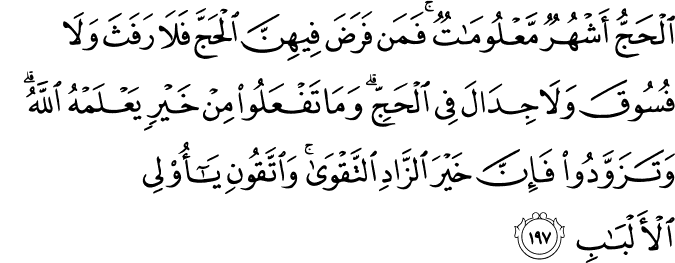


“For Hajj are the months well known. If anyone undertakes that duty therein, Let there be no obscenity, nor wickedness, nor wrangling in the Hajj. And whatever good ye do, (be sure) Allah knoweth it. And take a provision (With you) for the journey, but the best of provisions is right conduct. So fear Me, o ye that are wise.”
[Al-Baqarah, 2:197]


My dear brothers and sisters,

Today we are reminded again of the life of Ibrahim a.s., the prophet chosen by Allah, who became an example and role model to all of mankind. Allah said,





“And who would be averse to the religion of Abraham except one who makes a fool of himself. And We had chosen him in this world, and indeed he, in the Hereafter, will be among the righteous. When his Lord said to him, "Submit", he said "I have submitted [in Islam] to the Lord of the worlds.” And Abraham instructed his sons [to do the same] and [so did] Jacob, [saying], "O my sons, indeed Allah has chosen for you this religion, so do not die except while you are Muslims."
[Al-Baqarah, 2:130 – 132]


Ibrahim’s state of Islam was shown with full submission to Allah, willingly prepared to face Namrud, king of Babylon, the strongest empire of his time. Ibrahim did not submit to Namrud and his government, nor did he submit to his father who supported Namrud to an extent where he was sentenced to death by fire, ousted from his homeland by Namrud and his father.

He was then ordered to send his family; his wife Hajar and son Ismail a.s. to a dry valley where there were no foliage, no living soul, no water, and no fire. Ibrahim fulfilled the obligation with total obedience.

When he left his wife and son, he was asked by his wife,

“Did Allah command you to do this?”

“Yes.”

“Then Allah will not abandon us.”

Hajar too submitted to Allah, willingly left alone with her son in the valley without anyone to accompany them. Yet under such circumstances, she managed to hold steadfast while tending to the young Ismail. And when the situation reached its climax, Allah bestowed upon them the well of Zam Zam.

This goes to show that it is Allah who bestows upon us all that we have; wealth, health, scholarships, ease of life; not kings, nor governments, nor people with high ranks. They are but trust holders to all that belongs to Allah. It also shows that Allah’s bounty exists even in unthinkable places.

When Ismail reached an age where he could walk, and where he could help his father with his works, Ibrahim was tested with a command from Allah that he sacrifice his son.
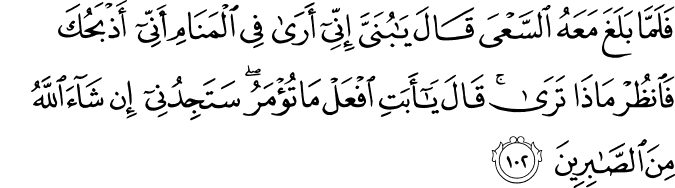


“And when he reached with him [the age of] exertion, he said, "O my son, indeed I have seen in a dream that I [must] sacrifice you, so see what you think." He said, "O my father, do as you are commanded. You will find me, if Allah wills, of the steadfast."”
[As-Soffaat, 37:102]


Ismail who was still young believed in his father’s prophecy, believed in Allah’ commands. And because it was Allah’s command, it must be fulfilled. We belong to Allah. It is He who has created us, who has given us the blessing of life, who has given us all the faculties that we have. All of it belongs to Allah.

Ibrahim knows that he belongs to Allah, and whatever Allah asks, he must fulfil, even though it meant sacrificing his beloved son.


When the command was about to be fulfilled, Allah commanded Jibril to nullify the command, stating that it was merely a test of faith. That is the meaning of Islam, the meaning of submitting to Allah; willing to sacrifice even the priceless of possessions for His cause.

Let us evaluate ourselves. Are we really Muslims who wholeheartedly submit to Allah; believing and accepting all the laws that relate to his Oneness even though we have never seen Him, the laws that relate to His angels, rewards and sins, and the hereafter even though we have never seen them?

The laws that relate to ourselves; Allah’s command that we cover ourselves, that we take only what is Halal and leave all those that are prohibited, that we marry and not commit adultery, and all the laws that define what is good and what is evil?

A true Muslim submits himself to all of His commands. Whatever He commands is beneficial for us, and whatever he prohibits is nothing but disadvantages for us in this life and the hereafter.

A true Muslim never doubts ever for a minute all the laws that Allah has prescribed even but a single letter.

Sadly though, there are many Muslims today who object to these laws, insisting that the teachings of Islam are not conducive in this time and age, insisting that the laws are discriminatory when they know and admit that all the laws found in the Quran and sunnah are authentic. For these people, Allah has questioned them in the Quran,



'Say, "Would you acquaint Allah with your religion while Allah knows whatever is in the heavens and whatever is on the earth, and Allah is Knowing of all things?"'
[Al-Hujuraat, 49:16]


In this verse, Allah is asking them, “Are you trying to teach Me about how life should be led when you know very well that I know best of all the things I have created?”

We are all the creation of Allah, thus only He knows what is best for us.


My dear brothers and sisters,

Never even for once in your life think that just because we were born as Muslims, having inherited the religion of Islam from our ancestors that we have already a first-class ticket to enter Paradise. Just because we are readily Muslims does not give us the authority to live life as if there were no rules.

Even though we have been chosen by Allah to be in the right path, there are chances that somewhere along the way we will be led astray. An opportunity given to a student to enter university does not guarantee his leaving with a certificate. There are chances that he may drop out.
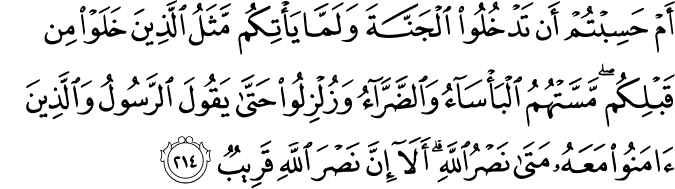


“Or do you think that you will enter Paradise while such [trial] has not yet come to you as came to those who passed on before you? They were touched by poverty and hardship and were shaken until [even their] messenger and those who believed with him said, "When is the help of Allah?" Unquestionably, the help of Allah is near.”
[Al-Baqarah, 2:214]


This life is filled with challenges. Whatever we wish to achieve, we must work for it. There are times when Allah grants us of what we seek, and there are times when Allah does not grant it to us, or postpones it to a later time. That is why we must always be in full state of submission to Allah, for He knows what is best for us, and what is not.

This day of Adha reminds us that we must struggle to achieve our goals in life, that life is full of obstacles, and that we must face it while not losing faith in Allah. Sacrifices will have to be made along the way. Remember what Allah has reminded us,

“Indeed, Allah will not change the condition of a people until they change what is in themselves…”
[Ar-Ra'd, 13:11]


Ibrahim faced the threats of being burnt alive and ousted from his homeland. Hajar willingly resided in the valley with his son. Ismail willingly let himself be sacrificed. All the trouble they went through, just to fulfil Allah’s commands and to gain His pleasure. Despite the harshness and complications they had to endure, they went through it, believing that Allah will never abandon them. They were the chosen ones, and the beloved of Allah. We ourselves are but ordinary people, thus we have to remind ourselves that we have no provision of being trouble-free.

Only Allah and He alone has the power of determining our fate, our wealth, and our tranquillity. No man, no king, no president, and no government have such power over us. Bear that in mind. Work for it, and submit to Allah that He may grant you of what you desire.




“Let them worship the Lord of this House, who provides them with food against hunger, and with security against fear (of danger).”
[Quraysh, 106:3-4]


SECOND SERMON

My dear brothers and sisters,

If a person loves someone he will do everything in his power to please the latter and hopefully achieve something in return. But if he hates the latter, he will do all that he can to fuel that sense of hatred.

If we love Allah, then we should submit wholeheartedly to him, and do everything in our capacity to gain His pleasure, and to abide by all his commands.



“Say, [O Muhammad], "If you should love Allah, then follow me, [so] Allah will love you and forgive you your sins. And Allah is Forgiving and Merciful."
[Aali-‘Imran, 3:31]


Let us on this day feel the greatness of the reward of Islam and Iman bestowed upon us by Allah. In fact, we should feel very proud of it. Only death while in faith and Islam will be acknowledged by Allah.



“O you who believe! Fear Allah the way he deserves to be feared. And do not die except as Muslims in full state of submission to Allah.”
[Aali-‘Imran, 3:102]


Remember that on this day Muslims from all walks of life have gathered in the holy city of Makkah. Let this be living proof that despite coming from different backgrounds, we are but brothers; we submit to one Allah jalla jalaluh, we acknowledge that the prophet Muhammad S.A.W. is His messenger and our role model, we make the Quran and sunnah as our guide in life, and we prostrate the same direction.

Once we are Muslims, there is nothing that segregates us in any way, with the exception of our level of taqwa.

We ask Allah to keep us in the right path and avoid us from being led astray.

Sunday, 11 September 2011

A Sermon (Khutbah) in Melbourne

On the 31st of August 2011, I was asked to give a sermon in Clarinda, a suburban district south-east of Melbourne. The members of audience were mostly Sri Lankan Muslims. The Eid mass was under the coordination of the ASLAMA (Association of Sri Lankan Muslims in Australia).

The contents for the sermon were considered based on the situation of Muslims in Australia:

1. Where there is a need for Muslims to acknowledge other fellow Muslims regardless of ethnicity.

2. Whereby it is essential for Muslims in Australia to spread and preserve the message and good impression of Islam.

3. Whereby Muslims must be reminded of the history which led to the deterioration of Islamic knowledge physically and mentally.

The actual sermon differs from the text as dependence on this text was not permanent, and figure of speech and spontaneous examples have innovated the main structure of the sermon.


FIRST KHUTBAH

Praise is to Allah who hath guided us to this; and we would not have been guided if Allah had not guided us. We praise Him, we seek His help, and we ask for His forgiveness. Whomever Allah guides, no one can lead him astray, and whoever is led astray by the will of Allah, no one can bring him back.

We bear witness that there is but one Allah, and Muhammad S.A.W. as his messenger, and the last messenger appointed by Allah.

O servants of Allah! Fear Allah! Fear Allah the way he deserves to be feared. And do not die as Muslims in full state of submission to Allah.

My Brothers and sisters,
We give thanks to Allah for having given us the opportunity to accomplish the month of Ramadhan and all of its fulfilment, so that we may fulfil what has been prescribed by Allah;

"…so that you are able to complete the period (of fasting) and to glorify Allah for that which He has guided you; and perhaps you will be grateful."
(Al-Baqarah: 185)

To be grateful, because of Allah’s reward in His guidance of making us as Muslims. Thus it has become our responsibility to fill our Islamism with perfect faith and good deeds.

My brothers and sisters,
We have just completed a big act of worship in Islam; that is to fast throughout the holy month of Ramadhan. We have been invited to be the guest of Allah during Ramadhan, to be served with the act of fasting, in which the reward of performing so is at least ten times that of a common good deed.

Allah has prescribed upon us,

“O you who have believed, fasting has been prescribed upon you as how it was prescribed upon those before you, so that you may become righteous.”
(Al-Baqarah: 183)

The reason is so that we become righteous to Allah; who fulfil His commands, and leave all that He has prohibited while we live on this earth, in our relationship with Him, in our relationship amongst ourselves, in our relationship with our wealth, and in our relationship with all living creatures that are around us. All these relationship must comply with all that Allah has commanded and prohibited.

This means that only with the characteristic of righteousness…or taqwa, that we are able to fulfill these relationships.

My brothers and sisters,
On this great day, I wish to share with you a verse from the Holy Quran, from the book of Al-Ma’idah, verse number 8 which goes,

“O you who believe! Stand out firmly for Allah and be just witnesses and let not the enmity and hatred of other (nations) make you avoid justice. Be just: that is nearer to taqwa, and fear Allah. Verily, Allah is Well-Acquainted with what you do.”
(Al-Ma’idah: 8)

First of all; Allah is reminding us so that we become a servant of Allah to establish truth all the time. It is a commandment from Allah that we establish truth irrespective of wherever we are.

As far as the duty is concerned, we must establish truth all the time wherever we are, at whatever era we are in.

Secondly, all of us are witnesses of what we do; witnesses of what other people do. So of that respect, Allah commands us to be a just witness.

Thirdly, Allah commands us not to allow our feeling of hatred towards another race, another nation, another creed make us become unjust. And Allah commands us to be just (I’diluu), for that is very close with taqwa. And in that respect, we must fear Allah, for He is well acquainted, well informed, no matter how large, how small, how public, or how discreet of the things that we do in this life.

Many of us who are here today originated from a land of mixed races. Even here in Australia we live amongst people of multiple races. To some, this is not something new as it has already been experienced in their native countries. To others, it is of a new experience if they were from a country of single nation, or grew up knowing little about those who exist outside of their respected tribes.

Brothers and sisters,
Most Muslim nations throughout the world would have once been living under colonial rule for many, many years. Most nations with majority Muslim population in one part of history have been colonialized, to an extent that they have forgotten the regimes which were set up by these colonial powers had been regimes that were subservient to their masters.

The governments that have been established and legitimised by the colonial powers were those that were of total obedience towards their masters. Henceforth our predecessors have been living under those conditions for many years. It could be 20 years, 50 years, or 100 years; depending on how long these territories were colonialized.

The trouble with many of these Muslim nations now is that we are suffering from a syndrome of trying to defend our race and blithering other races. As a result of that, nation states were created; splitting us apart, disintegrating us from what we used to be; a united force, a unified force at one point.

And today, we remain disintegrated. Because; I am a Malaysian, I am a Sri Lankan, I’m an Indonesian, I’m a Lebanese, I’m a Pakistani, I’m a Turk, I’m an Indian, I’m an Australian. These are the lifestyles that we have been caught into.

Many of us do not realise that when we hate other nations on the fact that we are predominant, that is a cause of zalim. The exact opposite of justice is injustice or zalim. Allah reminds us in this verse that if we are just, then we are close to taqwa. But if you are unjust, definitely you will suffer the opposite.

This verse tells us that one of the major causes of injustice is the hatred towards another nation, another race, another tribe, or another creed. The reason why Allah declared war on the Jews…the children of Israel was because of their arrogance in claiming that they were the chosen ones, the noblest of all tribes. No other tribes supersede them. Their hatred towards others can be seen today; how they try to obliterate our brothers in Palestine, how they try to destroy the minds of Muslims worldwide with countless hedonism.

Their act is positively against the verse I mentioned. Their hatred towards those other than their own kind has caused them to become vicious and unjust. And they will never rest until they are submitted to.

“Never will the Jews or the Christians be satisfied with you until you follow their form of religion.”
(Al-Baqarah: 120)

Yes, they are happy that we are living their way of life; eating, sleeping, and dressing as how they do. But as long as we remain as Muslims, their struggle will not stop.

Brothers and sisters,
Have we learnt anything from the worship of fasting throughout Ramadhan? During Ramadhan, we have observed hunger and thirst. And by observing these, we are reminded of the people in other parts of the world who are also fasting; not because of the obligation during the month of Ramadhan, but because that is how they live.

They do not have enough to eat, they live in poverty. And we can see that a majority portion of these people are but our brothers in faith. There’s not much that we can do to assist them. Why? Because we are not united as Muslims. After years of colonisation, we still uphold the ideology of nationalism. And with this ideology, we tend to be ignorant of other people who are not of our kith and kin.

We are defenceless in protecting ourselves, our brothers, and this religion. We lack the knowledge of defending the teachings of Islam, to an extent that we submit to the ideology of other people who are clueless of the teachings of Islam.

We have observed from history; when a Muslim territory faced invasion by a common enemy, Muslims would travel across the land to join their brothers in fighting off the enemy. They would put aside their geographical factors in favour of defending a Muslim territory.

In today’s world; when Afghanistan was attacked, when Iraq was attacked, when Palestine was constantly bombarded by the enemies of Allah, the government of neighbouring Muslim countries would act as if nothing happened. Even if there were people who went to help defend these countries, upon return to their respected countries they would be charged for treason or supportive of terrorism. The act of total unjust and hatred was bred by a single cause of hatred towards others.

Brothers and sisters,
We are among the people chosen by Allah to travel to this country, be it for the purpose of education, or to permanently reside here. For some of us, we have more breathing space to practice Islam as a whole compared to our native country.

Take this opportunity to increase your knowledge of Islam and at the same time your righteousness…or taqwa to Allah, because as I have mentioned earlier only with taqwa that we are able to accomplish our relationship with all that is around us. And only with taqwa we can be united as Muslims.

But always be aware that while we are in a free country, there is no limit to anything. And because of this we are liable to be led astray from the right path.

And while we are at it, we are being placed amongst people of different backgrounds. Learn from each other, and spread the true knowledge of Islam as wide as possible, according to your respected strengths.

“O mankind! We created you from a single (pair) of a male and a female, and made you into nations and tribes, that ye may know each other (not that ye may despise (each other). Verily the most honoured of you in the sight of Allah is (he who is) the most righteous of you. And Allah has full knowledge and is well acquainted (with all things).”
(Al-Hujuraat: 13)

The verse I mentioned tells us that this life is a life of ta’aarafuu or acquaintance. Everything we do in life begins with acquaintance. To understand Islam, we must first be acquainted with Allah. Awwaluddin ma’rifatullah.

To be united as Muslims, we must be acquainted with fellow Muslims. When we get to know our brothers we generate brotherhood. A combination of brotherhood and taqwa will eventually lead to unity for the sake of Allah. There is a Malay proverb which goes,

“Tak kenal maka tak cinta.”

If you do not know, then you will not love.

With that I conclude the first sermon.


SECOND KHUTBAH

Brothers and sisters,
A former Malaysian Member of Parliament, the late Fadzil Noor once said,

“You must be in a congregation, and do not let a day pass without thinking about Islam.”

His reference of congregation…or jama’ah does not mean this particular congregation where we gather under one roof to pray. His reference of congregation refers to Muslims who team up together for the sake of Allah to uphold this religion…teamwork if you like.

And when he said “thinking about Islam”, it means to think about contributing to Islam. Anything we do in life, we cannot accomplish it alone. We need the help of others. That’s where the concept of ta’arafuu comes in. Different people have different knowledge. And the knowledge we require may lie with them, and the knowledge they require may lie within us.

The prophet Muhammad S.A.W. said,

“You must be in a congregation for indeed being in a congregation is a grace, and disunity is a torture.”

We as Muslims have a responsibility to uphold this religion. Give contribution to Islam in any way that suits you most. If you have the knowledge of Islam, how fundamental it may be, then spread it to others. To spread Islam does not necessarily mean you need to have a background in Islamic Studies. Your knowledge and practice of what you know about Islam without doubt is sufficient.

I myself am not of Islamic Studies background. At this moment in time, I am an Electrical Engineering student. I spend my time studying the science of electricity. With the little knowledge of Islam that I bear within me, I share it with you today. And what I have shared with you, you must share with others. The prophet said,

“Pass on from me even though it is but a sentence.”

For many years, a vast majority of Muslims faced obstacles in the effort to gain Islamic knowledge, especially those who reside in countries governed by Muslims. Even if there were provisions for Islamic studies, it would be such that a Muslim only understands Islam as being the salaat, the zakat, fasting, and pilgrimage.

This trend dates all the way back to the days of colonisation. The colonies; the Spanish, Portugese, Dutch, and British alike were at war with the Muslim world even before colonisation. So it is not something surprising that when they invaded our countries, they condemned Islamic movements, and appointed people who were subservient to them to limit Islamic practice up to only the basic worships which are salaat and fasting.

The concept of da’wah at that time was only to tell people to do good deeds. But nothing on forbidding all that is evil.

Because they knew; they have learnt from the crusade against Jerusalem that Muslims cannot be brought down by force. Muslims are united in mind and strength. So they instead decided to bring down the Muslims through manipulation of the mind.

Now we are witnessing the chain reaction of that manipulation. Our lack of understanding about Islam as a whole has caused us to be disunited among ourselves. We lack the knowledge of Islam to an extent where we are subjected to abuse by the orientalists without having the strength to retaliate.

Because of that, we do not understand why we exist as different individuals. We do not understand our role on this earth.

That is why, I appeal to all of you, to enrich your Islamic knowledge, and to live by the Quran and the Sunnah. The prophet said:

“I leave behind me two things that if you abide by them, you will never go astray; the Quran and my Sunnah.”

It is never too late to gain knowledge. The prophet said,

“Seek knowledge from the cradle to the grave.”

This world contains unlimited amount of knowledge. The knowledge we possess is but a single drop of water on the tip of our fingers, compared to Allah’s knowledge which is as wide as the waters on this earth. All the knowledge on this earth; politics, science, medicine, mathematics, and engineering is related to Islam. There is no segregation or secularism between worldly matters and knowledge, and that of Islam.

May the knowledge that you possess lead you towards taqwa, and may our taqwa unite us into becoming a single Muslim congregation worldwide.

Wednesday, 18 May 2011

Of Migration & Freedom

Mother once mentioned to me that music from eastern America are more smooth and easy-going, whilst those from western America are more lively. From that on, I took interest in the expansion of civilisation.

The early settlements of America were on the east coast. Later, people migrated further westwards seeking new life, and we can tell from cowboy movies that the people in the west were more lively and free, if you like.

In the modern day, migrations are more inclined towards Australia. Professionals, refugees, and asylum seekers would head for Australia or other developed countries in search of better jobs, liberation, and quality of life.

They would leave their countries that were in turmoil, dictated, or economically devastated, not to mention the legislation and constitution.

Among those who migrate are the Muslims. Many who migrate seek better space to practice their faith, whilst some too try to be free of it.

No matter where we are, we can never be seperated from the teachings of Islam. Even though some countries regard religion as a mere hobby, does not mean that we too can treat Islam as a hobby. Islam is not just a religion, it's the way of life.

Being in a non-Muslim country, our responsibility is to uphold its teaching and showing to others what Islam is all about. But because appealing Muslims disregard their religion, and took to the life of no limits, Islam is thus considered by others as nothing but a plain ideology.

A few days ago, I was watching the news. News on crimes, hoodlums, and vandalism are common. But what shocked me is that the name of the perperators were not Nigel, Bruce, or Harry. No sir, the names were Mohamed Yasin, Abou Nasser. These are names of Muslims. Muslims committing crime in a non-Muslim country.

No wonder Muslims, immigrants are being hated all around, even though they know very little about Islam, and many do not consider readin about Islam before making personal theories. Just because you live in a free country, doesn't mean that you can be stupid and act freely.

Remember this; you are a Muslim. You live by the Book and Sunnah which describes everything that you do in life. No matter where you go, they must never be segregated. You are in a deprived land, you live by it. If you are in a free country, you still live by it.

There's no use nor benefit trying to copy their ways of life, dressing, for Allah has already reminded us,

And the Jews will not be pleased with you, nor the Christians until you follow their religion. Say: Surely Allah's guidance, that is the (true) guidance. And if you follow their desires after the knowledge that has come to you, you shall have no guardian from Allah, nor any helper.
[Al-Baqarah, 2:120]

Stick to your religion no matter where you are, and live by it. If you stick to the teachings of your religion, you will unite with your fellow Muslims, and with united Muslims, this religion shall be ridiculed no more. People will respect Islam and its worshippers.

Tuesday, 28 December 2010

Hijrah: The Microscopic View Of A Man's Journey & The Life-Size View Of His Destination

A couple of months back, I was asked to give a view on one of my companions' statement. The statement is regarding the challenges and mockery faced by an individual whenever he/she is determined to make a change. The term I'm using for this particular description is 'Hijrah', which despite it's pure Arabic interpretation, is also interpreted in religious terms as,

"The journey of transforming from bad to good".

Hijrah is mentioned in one of the compendium of the 40 Hadiths which goes:

"Actions are but by intention and every man shall have but that which he intended. Thus he whose migration was for Allah and His messenger, his migration was for Allah and His messenger, and he whose migration was to achieve some worldly benefit or to take some woman in marriage, his migration was for that for which he migrated."

However, I am not going to discuss about the contents within this particular hadith. What I’m trying to bring forward is the mentality of today’s people upon those who are intending to make a change, generally from bad to good.

For years, I have been presented with roughly the same type of question,

“Why is it that people mock me when I want to make a change?”

My answer would be,

“Because they have not seen the changes occur.”

“But, I am making changes.”

“I know you are, but do they know? No sir, their focus is on the change.”

That is the fact today; people judge others by means of what they produce, not on their effort to produce. Such a fact takes place anywhere; in organisations, in politics, and even on an individual.

Hijrah itself requires a journey that has to be endured. When you want to go from Kuala Lumpur to Alor Setar, you have to endure the journey along the North-South Expressway. Everything in this life requires some sort of journey. Why, even the flicking of a switch has its own microscopic journey. How’s that?

From the view of a normal person, a switch has only two conditions; ON and OFF. However, in the knowledge of Power Electronics, switches have another condition, known as the TRANSIENT condition. This condition is where the journey from OFF to ON occurs and vice versa. This is only visible on a microscopic scale.


Viewing from a general distance, the ON-OFF transition is viewable from a scope, and is shown to be in the form of a square wave, where the change between the two conditions happens abruptly. But if the scope is zoomed in, as microscopic as possible, it will be shown that there are waves between the two conditions. These waves represent the ‘journey’ from one condition to the other.

In relation to the issue brought up, many would assume that when someone wants to make a change, the change would take place abruptly. And when no change occurs, the assumption would be that the person is a hypocrite, because the change was not seen.

What many failed to consider, were the steps/efforts taken to make the change. What many did was to judge from a distance, and not to the extent of a microscopic level.

Weren’t we all taught that Allah judges a man not by what he can produce, but by the effort he has made to produce? Why so? Because it is by His will, and His only that man can produce.

If Allah does not judge a man by what he produces, then who are we to judge a man by what he produces???

We know of a man who is on a journey from Kuala Lumpur to Padang Besar. By Allah’s will, he did not arrive because his car broke down somewhere in Changkat Jering.

Do we call him a hypocrite for not arriving in Padang Besar?

No.

Why?

Because we know that he has already executed his intention by noticing that he is headed for Padang Besar. So, what difference does it make compared to those who say they want to make a change, but their ‘journey’ is not visible to the naked eye?

So, never judge a man by what he produces. No one has the power to produce. It is only by the will of Allah that man can produce. Man can only work to produce, and pray that Allah will see fit for him to produce.

Wednesday, 14 July 2010

Cry Freedom - A Tale of Struggle For Equality

A couple of weeks ago, I watched a film on Fox Classics channel. It was titled Cry Freedom. The first time I watched this film was about ten years ago back in Malaysia. The film describes the days of South Africa during the Apartheid period.

It focuses on two real-life characters; Donald Woods, a South African journalist cum anti-Apartheid activist who befriended Steve Biko, a black activist.

In general, the film depicts a scenario of segregation among the whites and the blacks by all means of medium (i.e. public amenities, essential rights), and oppression of the security police towards the black community.

Throughout the time frame of this film, Steve Biko has been placed under house arrest; not being able to communicate with more than one person at any given time, ad restricted to travel within a certain boundary.

He was arrested as he was travelling to Cape Town to address a black youth's gathering. Eventually, he died in prison. The government described his death as caused by hunger strike. In reality, his death was a result of beatings while in prison.

Woods, during a visit to the mortuary secretly managed to capture snapshots of Biko's body with the help of a fellow journalist. Having obtained these, he decided to expose it internationally, but was arrested at the airport and was placed under house arrest.

However, Woods and his family managed to escape South Africa and seek asylum in Britain through a series of hitch-hiking, rendezvous to Maseru in Lesotho and then flying to Botswana.

This film really captures the heart of its viewers, judging by what one has to face in his struggle for justice, equality, freedom. Along the way, he risks losing his possession, his ease of life, and to a certain extent, losing his life.

In everything we do in this life, the journey to obtaining it is not always plain sailing throughout the way. There will always be resistances. There is nothing in this world that we achieve without toil and sweat...with the exception of cheating.

Struggling to achieve our goal and purpose is difficult at times. But once we get what we struggled for, victory is at its sweetest. Furthermore, we will appreciate our victory judging by what we had to go through previously.

But always remember, it is Allah and only Allah who decides whether we will achieve victory or otherwise. We as His servants can only struggle and pray for guidance. There is no such thing as success through strategic planning. It is only by His will that we shall ever see victory.

Man could spend endless hours of strategic planning, recruiting geniuses, investing millions. But if Allah does not grant victory, then man will not achieve it. But that doesn't mean Allah will never grant victory. He will, in due time, when the situation is right. We can only struggle and ask Him for success.

It takes one who has such an experience to understand this fact.

The song below, Nkosi Sikeleli Africa was illegal during the Apartheid period, and was sung during political meetings and gatherings. the song used to be a symbol of hope and unity. Today, it is part of the South African national anthem.

Sunday, 3 January 2010

Ye Olde Times

I have been living alone for the last month as my housemates have returned to Malaysia. Furthermore, with Rashid leaving his car in my care, I've been spending certain days driving around Melbourne...usually on official matters rather than leisure.

Eversince I moved to the City, my expenditures were somewhat erratic. Luckily my tenancy was not a year-long tenancy, so I still have the option of moving back to the inner suburbs where the cost of living is low.

With the advantage of a car in possession, I decided to do my groceries in various locations, usually being either Brunswick or Footscray. But most of the time I'd go to Footscray as I could get Asian stuffs there. Besides, everything was within reach; fruits and vegetables at Footscray Market, Halal butcheries at either Droop Street or Nicholson Street, and the Turkish restaurant where I would buy their fresh arm-length Turkish bread.

For items available in supermarkets, I'd just pop over to Highpoint Shopping Centre where the Safeway supermarket is located.

Hey, Footscray and neighbouring Maribyrnong was my hometown, and still is, seeing that my campus is situated within it.

This morning, I decided to do my weekly shopping. On my way to Highpoint Shopping Centre, I drove along Droop Street via the tram terminus. Without realising, I was driving down memory lane.

While driving at 30km/h (because a tram was in front of me, stopping frequently), I passed by a couple of landmarks. The first was the Footscray Motor Inn, where I stayed overnight upon arrival in Melbourne. While along Gordon Street, I noticed the landmarks I used to observe and knew by heart during the time when I commuted via bus or tram from campus to the Student Village, which was close to the shopping centre.

Thus I suddenly recalled my early days in Melbourne...which was 6 months back. It was those days when I was still trying to get used to the suburb's environment, learning to use the public transport, and finding out the destination of each bus that enters Footscray town.

Furthermore, I had no contact within the area during those trying times, being all alone in that Student Village, with my family being thousands of miles away. Wherever I go, I go alone. But in a way, it was fun and relaxing, as I was not bounded by any curfew restrictions, or following people to wherever it is that I do not intend to go to.

Now, look at me; a 'never die' chap who knows his way around Melbourne and its suburbs without having to carry a Greater Melbourne Street Directory around with him. Wherever I go, I know which train, tram, bus to take, which lane to drive on and how to avoid rush-hour congestions.

Time has truly gone by...

Friday, 6 November 2009

Sin vs Da'wah

Imam Hasan Al-Basri once said,

"O mankind, truly I am advising you, and that doesn't mean that I am the best amongst you, and doesn't mean too that I am the most pious amongst you. Even I have exceeded upon myself."

("Wahai manusia, sesungguhnya aku sedang menasihati kalian, dan bukan bererti aku orang yang terbaik di antara kalian, bukan pula org yang paling soleh di antara kalian. Sungguh, akupun telah banyak melampaui batas terhadap diriku.”)


On another occassion, he said,

"If a Muslim does not give advice to his brother except when he has become perfect, then there will be no one to advise others. There will be very little of those who will want to advise others, and none will perform da'wah in Allah's way..."

(” Andaikata seorang Muslim tidak memberi nasihat pada saudaranya kecuali setelah dirinya menjadi sempurna, nescaya tidak akan ada para pemberi nasihat. Akan menjadi sedikit jumlah orang yang mahu memberi peringatan & tidak akan ada orang yg berdakwah di jalan Allah….”)


(Mawa’izh lil Imam al Hassan Al-Basri, pg. 185-187)

Thursday, 22 October 2009

The Journey Along The Great Ocean Road

Saturday, 3rd October was the second last day of my midterm break. And after a whole week finishing my assignments, finalising my semester project, fulfilling commitments, I have pre-arranged for this day to be fully occupied by me, myself, and I.

A couple of weeks previously, I planned to day-travel to a destination outside of Melbourne. The destination itself was either to Ballarat, The Great Ocean Road, or Dandenong. To go to Ballarat, I can just take the V/Line train. To Dandenong, I can just take the metropolitan train, free of charge, as I hold a monthly travelcard, which allows me to venture into Zone 2 during weekends, where Dandy lies. I was spoilt for choice.

On the 30th of September, I calculated my monthly expenditures on the Excel. And, after calculating the remaining balance, plus balances from the previous months, I found out that I have managed to save up a wealthy sum of money, despite the fact that the University officials were delayed in returning my accommodation refund.

And so, I decided to rent a car and drive along the Ocean Road.

On Friday, after congregation at Newport Masjid, I went to Footscray town. There’s a Thrifty rental office there. I browsed the internet previously and found out that I could get a small car for $42 at the Footscray branch. However, when I enquired at the office, I found out that most cars were sold out. The only one available is either a Ford Mondeo or Toyota Camry which goes for about $130!

My next option is the Budget car rental which is about a couple of blocks away. Sadly, they too were sold out. I was devastated. I considered calling the trip off, when I suddenly remembered that there are rental centres throughout Franklin Street, which is next to the RMIT Swanston Street campus. So, I decided to take a last shot before calling it off.

My first stop was Budget. But there was a queue there. Next door is AVIS. No, AVIS is a bit expensive from what I recalled. Further down is Europcar...I’ll consider it as a last resort. Next to it was Hertz. I didn’t know why, all I knew was that I ended up at their front counter.

I enquired about the availabilities for the morrow. The clerk said that that there are cars available, and asked for details of the car I intended to rent. I simply mentioned that I want the smallest car available, manual or automatic. A friend once suggested that I go for the high-powered cars

He then said that the smallest available is a Class C Toyota Corolla sedan. He then asked if I am a student. I said yes, and he said that I am eligible for a student’s price, and that makes a total of $64.90, inclusive of admin charges, GST and Driver Under 25 Surcharge, which is roughly between $15 to $25.

Usually a Class C would cost around $65 - $70, excluding the external charges. Clearly there was a hidden wisdom when Budget was out of cars, and Thrifty had only Mondeo and Camry cars. I also requested for the fuel pre-purchase option of which they offered at a rate of $1.12/litre. The advantage of this is that I can return the car with the tank almost empty, without having to refill it. Furthermore, the price of petrol for that particular period was between $1.18 to $1.30 per litre, depending on outlet.

On my way back, I stopped by at Coles supermarket in Altona town to buy some snacks for tomorrow’s trip. I had some thought as to what food to bring. And then I recalled; back in England when we travelled to the countryside, or over a long distance; Nottingham, Loughborough, Bath, or the seaside, Abah would just buy crisps, sandwiches, and a bottle of Lucozade each. Sometimes, Mak would cook something from home.

That I could just do...minus the sandwiches, as sandwiches here are not as variable as those in UK. Furthermore, a packet costs $5.50! At that point in time, I can’t make sandwiches at home as I was out of stuffs to put on the bread. So, I just packed a few packets of plain crisps, a packet of nuts, freshly-baked cookies (gone stale the next morning... ), and a flask of water...yezzz... water is very important when I’m driving. I don’t know why, but whenever I drove over a long distance...beyond 2 hours, my throat seems to go dry.

The next day was the big day. But it was also a morning of disruption. On this day, the Werribee Line train service has been temporarily terminated due to construction works in Laverton. So, I had to take the replacement bus up to Newport, then take the train to Melbourne Central.

Having received the car I booked, my first destination was Geelong via the M1 (Princes Freeway). There, I was to pick up an old friend of mine, Nurul Alif As-Solihin (Alif Mastor). We’ve known each other since secondary school. Since I’ve never been to his house, I told him to wait in front of my sister’s house in Preston Street. My sister was away with her friends in Melbourne. He was the only one who was not doing anything on that Saturday, so I invited him to accompany me on this trip.

From Geelong, I took the B100 highway which would take me to Torquay; gateway to the Great Ocean Road. The travelling time on the initial portion of the Road was instantaneous, as the roads were wide and straight, contributing to a speed limit of 100km/h. But, as it goes further along the coast, the road goes up and down, and between hills, contributing to a speed limit of between 50km/h to 80km/h.

The first stop was the lighthouse on the coast of Aireys Inlet. Actually, I didn’t know that the place was called Aireys Inlet, not until I pondered over the road map. It was here that I had my first glimpse of what G.O.R. was all about.

Subhanallah! The beauty of it. The sound of waves, the crisp breeze, and the view of the cliffs along the coastline as far as the eye can see. It was a breathtaking moment. Having lived within the suburban for a couple of months, this turned out to be a good change for me.

Back in the car, I wondered where our journey would lead us to. No use asking Alif, as even he does not know where is where for the moment. My initial plan was to go as far as Lorne, and then back to Geelong via the country road. The clerk at the rental office suggested that I drive up to Warrnambool, one of the reason being that I’ve already pre-purchased a full tank of petrol, and that I should make the most of it seeing that it’s not refundable, regardless of fuel volume left in the tank.

Warrnambool is about 200+ kilometres down the Ocean Road, and about 3.5 hours drive judging by the road structure and signboard placed by the side of the road. I asked Alif about his plan for the day, he said nothing doing.

Seeing this, I decided to drive as far as I could manage. When I watched Discovery Channel a few years back, there was a saying in one of the advertisements,

“A true traveller has no destination, and is not keen on arriving.”

After a period of driving, we came to a town that I do not know the name of, probably missed the sign. Only after exiting the town, I caught a glimpse of one of the signboards and noticed the word “Lorne”. Only then I knew the name of the town. From the map, Lorne looked quite far away. Practically, it’s not that far. It’s true what the professor from Newcastle University said to me back in Malaysia,

“We Australians have a different opinion when it comes to distance. We have staffs working in the University in Newcastle, yet they live in Sydney. We also have people working in Sydney, but living in Newcastle. Like you mentioned, the travel time is roughly one to two hours. For you, that is one heck of a distance. But for us, it’s nothing. Australia is a big country, and two hours of travel is nothing to us...”

Judging by my current location, time, I decided to go further down the Road. Next primary destination is Apollo Bay, some 40 to 60 minutes away, if I’m not mistaken. The road between Lorne and Apollo Bay was long and winding, thus the average speed was only around 60 to 70km/h. Another reason for this was that the drivers ahead of me had this tendency of slowing down every once in a while to gaze at the scenery, or coastline.

It was at this time that Alif has started dozing off. Prior to reaching Apollo Bay town, there is a signboard which points to the direction of Geelong via the inner roads. The time was 2.00 pm, so I decided to drive further on. The next primary destination is Port Campbell, famed for the 12 Apostles. A large portion of the road between Apollo Bay and there was mainly inland, so there was less winding, twists, and turns, with the speed limit being 100km/h.

After about half an hour of driving, I started wondering as to where exactly I was currently situated. So, I stopped by the roadside and pored over the map. Clearly, I was somewhere between the two towns mentioned, but have no idea as to EXACTLY where I was situated. However, I was initially stunned when I found out the road which goes back to Geelong is in Warrnambool, roughly 2.5 hours away, but sighed in relief when I realised that I overlooked a minor road a few miles off Port Campbell which would lead me back to the main road back to Geelong and Melbourne.

And with that, I continued my journey. I can’t recall how long I’ve been driving since then. All I know is that I suddenly found myself arriving at the 12 Apostles National Park, about ten minutes prior to reaching Port Campbell.

I drove into the Park, parked my car, and went for a walk along the coastline (cliff) with Alif to gaze at the 12 Apostles...or what used to be 12 until a few of them collapsed recently. The walking and stretching was helpful, as I’ve been sitting for more than 2 hours. Not to mention being worn out. Well, what do you expect? I’ve not been driving for more than 2 months, I get the opportunity to drive, and went off half a thousand miles cross-country, in a land I’ve never driven before.

Having been fully stretched, we drove into Port Campbell town. I parked the car at the town square, and we walked around town. Having walked, the both of us felt hungry, and decided to find something to eat. I brought pizza slices, but Alif ate them all as he didn’t have any breakfast. Adjacent to where I parked my car was a Fish & Chips outlet. So, we bought a helping each, and ate on a bench by the sea. It was a wonderful feeling; eating whilst the salty sea air blowing into my face.

However, I was feeling a bit worried, as I usually avoided eating whilst on the wheel. But then again, compared to nasi campur in Tapah or Kuala Kangsar, fish and chips shouldn’t be too much of a digestion issue.

Having eaten, we got back into the car. We left Port Campbell behind us, and I drove a few miles up the Road before making a right turn into the C164; a country road which would take me across the countryside to the main road which goes back to Geelong. Based on the map, the route seemed long and winding. But then, winding as it may be, the road itself was wide, with a speed limit of 100km/h.

I drove for almost an hour before coming to the junction adjoining the A1 highway. From there, it was a swift drive back to Geelong, some 80 kilometres away. This particular road was wide and straight, with two lanes on occasions. Other than that, it’s just a normal country road (jalan lama as we call it). From where I was, I could see far up the road. It was a beautiful sight, with the sun and fields of daisies on either sides of the road.

We passed through several towns, the major one being Colac. The clock showed 5.30 pm. Maghrib was an hour away, and we have yet to pray Zuhr and Asar. At that time, I was just entering Winchelsea town. At the other end of town, I saw a public toilet sign, and decided to stop for a while, as I was getting a bit lightheaded.

I saw that next to the public toilet was a small grassy park facing a stream. So I took my sarong from the boot, and we prayed on the grass. Having prayed, I felt more refreshed (come to think of it, it always happens after each prayer) and we continued our journey. About half an hour up the road, we finally reached the outskirts of Geelong.

By the time we reached Alif’s apartment in Geelong CBD, it was 6.20 pm, a few minutes to spare before Maghrib. After having rested, and prayed, I left Geelong and headed back to Melbourne. I drove up the A1 northbound which would lead me to the M1 Princes Freeway. It has been quite some time since I drove at night.

As I reached Werribee, I decided to stop over at my house and drop off my things before heading to Melbourne. I took the Kororoit Creek Road exit and drove to Altona via Maidstone Street. I only stopped for about 10 minutes or so to unload my things, save my clothes, and headed back to the freeway.

At West Gate Bridge, there was a long crawl, as there were construction works throughout the bridge. After passing through the construction site, I started to look out for the Docklands exit which would take me into Melbourne CBD. Further than that, and I’ll have to pay the toll. There’s no toll booth. Everything’s electronic. They just simply detect the license plate number, and send an invoice. But I didn’t register my car with the concessionaire, and if I entered the toll road, I have 48 hours to register my car.

I entered Melbourne CBD via Flinders Street. There was a lot of traffic on that street that night. I wanted to enter Russell Street, which was along Flinders. The street entrance itself being next across the train station, and there were many pedestrians. Thus, I had to wait for pedestrians to cross before I can enter Russell Street.

From there, I drove all the way to Lygon Street and entered into Drummond Street, where Zaim resides. I spent the night there as I had to return the car by 9 the next morning.

When I returned the car the next morning, the invoice stated that I had travelled roughly 580 kilometres within one day. That is roughly similar to driving from Kuala Lumpur to Penang, and back again. Wow, never thought I could cover such a large portion of distance within a day!

It was an enjoyable day. But the most enjoyable of all is the driving itself. One thing I initially feared...which later turned into an obsession, was the traffic light pattern. Here, to make a right turn, you have to enter at your own will. Intersections with heavy traffic usually have guided traffic lights for right turns (like Malaysia). But others, you have to enter as if the traffic light had no electricity, in which you had to wait for traffic from the oncoming direction to clear before entering.

It’s just like entering UiTM on those days when there was an electrical failure. It was scary at first, but once I got hold of it...quite fun!

And then, there’s the Hook Turn, in which you take the right turn using the left lane. This one is a bit complicated to describe. You can read about it on this web address, ( http://en.wikipedia.org/wiki/Hook_turn )

Cheerio!!!


Wednesday, 2 September 2009

A Conversation...

Usually at home, I'd have dinner together with my Chinese housemates. Though not being able to consume their meat dishes, yet their vegetable dishes were of no problem, and they are welcome to have a pinch of whatever I cooked, meat or no meat.

However, since early Ramadhan, I've succumbed to dining on my own. As Maghrib is around 5.40 pm (as of 1 Ramadhan)...heading towards 6 pm and beyond as the days head closer to spring season, I usually start cooking at 4, and start eating immediately when the time comes.

This is because I'm rushing against time. I have to catch the 6.37, or 6.57 train to Newport to join the Tarawih congregation, which begins after 'Isya prayers, currently timed at 7.15 pm.

My housemates usually have dinner between 7 to 8 pm.

Anyhow, yesterday as I was tending to my cooking, my housemate came up to me,

"Err...Karim, are you doing anything on Saturday? I think I want to go to the IKEA in East Melbourne."

"No. I don't think I'm doing anything on Saturday. Should be OK," I said.

"Owh, OK. Are you still using the oven?"

"Just another 10 minutes. I'm cooling it down. By the way, you realised of course that I did not eat with you and Jared these last few days. You know I'm fasting, so I have to eat early when the time comes."

"Err, ya I know. Maybe someday we can go and buy Halal meat and we can all cook and eat together."

"Hmm...sounds good."

I have to admit that I was touched for a moment. Here I am with an individual with no religion beliefs (refer to China's Cultural Revolution effects), yet he knows my religious obligations.

However, this chap is seeking religion knowledge. He knows a bit about Islam in terms of prayer, fasting, and Halal meat. He kept asking me about Islamic lectures programmes. So far, I know none that would suit him. Those at Newport Mosque are in Arabic...one heck of a problem if I were to translate it to him in real time.

I'll have to check with ICV for any Islamic programmes. In the meantime, I'm trying to find a Quran volume with Chinese translation for him to read. It's the best method for understanding Islam. He knows about the Quran, only that he doesn't know the name, and only refers to it as Islam's text book. Hahaha.

So far, I've found none. ICV only has translations in Albanian, Urdu. I'm not in the mood to get him an English translation volume, as he is himself having difficulties conversing smoothly in English. Furthermore, the English translation uses Shakesperian English. Very classic, I must say.

Maybe I should go to Sydney Road in Brunswick. There are Islamic bookshops there. I've been wanting to go to Sydney Road for weeks now. It's been 2 years since I last went there. Owh, how I missed the fresh arabian delicacies (baklawah) the sell at Balha's Patisserie shop down Sydney Road (this is not due to the fact that I'm fasting!). I used to buy a boxful of them for mum last time.

Tuesday, 25 August 2009

Ramadhan in Melbourne - How I Go About My Day

My last Ramadhan spent outside of Malaysia was about 15 years ago, back in England. However, during those years being in England, I was still a child, knowing nothing about the obligations of fasting upon Muslims.

This Ramadhan, will actually be my second experience spending it outside of Malaysia...down Melbourne way, and the first time going through it with a matured understanding.

So far, there's not much difference than to that of fasting in Malaysia. Only that the southern hemisphere is experiencing winter for the moment, so the daytime is short.

On average, my day begins by waking up at 4am in the morning, and having my sahur in the kitchen. The mornings are cold and chilly, so it would usually take sometime if I was to heat my food on the stove.

At around 5.15 to 5.30, Subh would emerge, and I would perform my prayer. What happens after that would usually be various; either wash the dishes if I didn't have time to do it before praying, checking incoming e-mails on the internet, or sleep for another hour or so depending on last night's activities.

If my lecture starts at 9, I would catch the 7.59 from Westona Station, or the 9.59 if it was to start at 11. Classes usually end for the day at around 1pm. I would go and pray in the University musolla before walking back to Footscray Station...or taking the bus if it is within 5 minutes of waiting.

Upon reaching Footscray town, I would head straight into the station. If I have some groceries to do, I'd stop over at Footscray Market for vegetables and fruits, and one of the two Halal butchery for meat. If I have to buy other groceries, I would take the 411 or 412 bus to Altona Gate Shopping Centre on my way back home, which houses the Safeway supermarket. Usually, I'd prefer Safeway/Woolworths rather than Coles, eventhough Coles is available in Altona.

Once I've reached home, I'd pray 'Asr, and then start smoking the kitchen to prepare a meal for breaking fast later on.

After having broken fast, prayed etc., I would leave home and head for the station to catch the 6.37, or 6.57 train to Newport, some 10 minutes away.

There's a mosque adjacent to the Newport station where I would perform Tarawih prayers. This is an Arabian mosque, hence all forms of announcements are mostly being made in Arabic.

I'm not sure if their khutbah is in Arabic or English, because I've yet to perform Friday prayers there, as I usually perform so at Victoria University.

Here, Tarawih is only performed up to 8 rakaats. More than that, do it at home. After 4 rakaats, the congregation would pause from prayers, and give way to a brief tazkirah or short sermon...similar to what is practised at Masjid Batu in Permatang Pauh, Penang.

It's a beautiful experience; Muslims from all walks of life, from different races lining up under one roof to worship the One true God.

After that, I would return home, recite the Quran, prepare some meal for sahur, recap on any outstanding academic matters, and jump into bed.

Monday, 24 August 2009

Geelong


Last Thursday, I received an SMS from my younger sister in Geelong, telling me that my package from Malaysia has arrived. Finally, after a month going about bookless, I finally have the books I needed for my studies.

I decided to go to Geelong on the following Saturday. Come Saturday, it was the first day of Ramadhan. To go to Geelong by train, I have to catch the V/Line train. This train stops at either Melbourne Southern Cross Station, Footscray Station, Newport Station, and Werribee Station. The closest from Westona Station was of course either Newport or Werribee.

I chose to go to Werribee because I won't have to double back on the same route just to switch trains. The only disadvantage was that Werribee lies on Zone 2, whereas my monthly travelcard covers only Zone 1. So, I bought a Zone 2 Daily Travelcard.

Furthermore, the fare from Werribee is half the price of the fare from Melbourne CBD, not to mention it's the weekend, so there's an off-peak price, half the normal price.

The average temperature was around 7 Celcius and very windy throughout that day, somewhat unusually cold. So, I brought my jumper along just in case the weather drops further. The problem with Melbourne, is that the weather tends to change every 10 - 30 minutes.

I caught the V/Line train from Werribee at 12.26 pm, and arrived safely at Geelong Station at around 1 pm. From there, my sister met and took me to her house in Preston Street. Atiqah was busy with her submissions, so I prayed Zuhr, and went out to venture Geelong CBD. Atiqah told me to be back in time for Iftar (breaking fast).

I first went to the waterfront. Masya-Allah, it's so beautiful. The blue sea stretching out as far as the eye can see. Then, as I was walking along the Deakin University building, I came across a museum; Ford Discovery Centre.

Hey, nonny nonny, a museum! In it I must go. I got a concession's price since I was an enrolling student...though I was hoping that I'd get free admission. The museum was filled with arrays of Ford vehicle models, beginning from the infamous Model T, up to Australia's renowned Falcon.

The exhibition on the upper level was my favourite; the processes of designing and manufacturing a certain model of a car. I was more attracted to the instrumentation equipments which were on display.

After that, I went for a walk around Geelong, until I realised that I've not prayed 'Asr, and that Maghrib was closing in. So, I rushed back to Preston Street just in time to pray, an wait another half-an-hour before we broke fast.

After having eaten and prayed, I rested in my sister's room while waiting for 'Isya at 7.15 pm. The V/Line runs every hour or so. I decided to catch the 8.26 back to Melbourne. After having prayed and passing goodbyes, I headed for the station.

Chill winds passed by me as I headed down the lamp-lit street towards the station. The last time I walked in the dark, cold night was about a month ago. On the train, I gazed out into the dark valley. Though there was nothing visible, it sure was a peaceful view as dark outlines of the hills emerged every now and then.

As I reached Werribee station, a Melbourne metropolitan train was waiting across the platform. One thing I liked about travelling public was that everything was on time and that they are properly synchronised to meet connecting services. By the time I reached home, it was 9.40 pm. I had a quick hot shower, prepared my sahur meal, and flunked right onto the bed.